

 Heather Blackmon
You finish a workout feeling strong. Maybe a little tired, but “good-tired”.
Then the next day hits.
Just getting out of bed, you feel it immediately.
Your hips are tight.
Your legs feel heavy.
Everything feels a little restricted.
So you take a few minutes & stretch. And it helps for a bit, but by the next day… you’re right back where you started.
If you’re training consistently & still feel stiff between workouts, this is why.
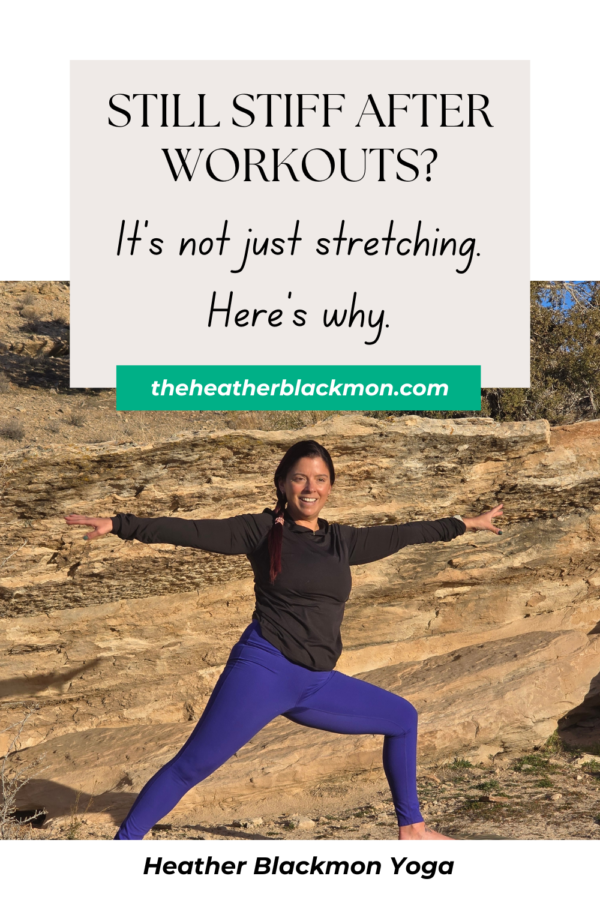
Why you feel stiff after workouts
Most active people assume the solution is simple: Do more.
Stretch more. Add more mobility. Try to “loosen up.”
But that’s not actually the issue.
The real problem is how your body is recovering between workouts.
Your body isn’t resetting between workouts
Every workout creates stress. It’s the good kind of stress, so this is good.
But your body doesn’t automatically reset after you’re done. It carries that stress forward. And if you don’t actively reset it, that stress builds.
Day after day.
That’s when you start noticing:
- tight hips that don’t loosen up
- reduced range of motion
- stiffness that shows up before your next workout even starts
This is why you feel stiff between workouts, even when you’re doing everything else right.
Why stretching doesn’t fix stiffness
Stretching can feel good. But most people don’t know how to get the most out of stretching. The most common approach I see is:
- a few quick stretches after a workout
- something different every time
- only when something feels tight
There’s no consistency and no progression to your stretching. So your body never really adapts.
That’s why the relief is temporary, and why you still feel stiff after workouts the next day.
If you want a deeper breakdown of this, read this next:
Why stretching isn’t enough for active people
The real problem is inconsistent recovery
Here’s what’s actually happening:
Your training is structured. But your recovery is not.
If you’re trying to get stronger, faster, or go further, you follow a plan.
But recovery usually looks like:
- squeezing something in when you have time
- skipping it when life gets busy
- guessing what to do
Without consistency, your body never fully resets.
And that’s why stiffness keeps coming back.
What actually works for recovery
The shift is actually simple: consistent, structured recovery.
And one of the most effective ways to reduce stiffness after workouts is yoga.
Short yoga sessions that:
- target the areas your training stresses most
- build on each other over time
- fit into your schedule
You don’t need an hour. You don’t need to do it every day.
2-3 times per week is enough to start improving recovery between workouts.
Less stiffness.
Better movement.
More freedom in your body between workouts
Start here, a 10-minute yoga reset
If you want something simple you can try right away: Use a short reset.
10 minutes. Focused. No guesswork.
This is exactly why I created the 10-Minute Yoga Reset. This short yoga reset is designed to help you:
- release tight hips and legs
- move better after workouts
- feel less stiff the next day
Try the 10-Minute Yoga Reset here
Start with that.
Repeat it a few times this week.
Within a few sessions, you’ll start to feel the difference.
That consistency is what actually creates change.
If you want a plan (not just a one-off)
The 10-minute reset works. But the real shift happens when your recovery becomes structured.
That’s what Outflow Studio is built for.
Short, progressive yoga classes designed for runners, lifters, riders, and active people who want to feel better between workouts.
So instead of guessing what to do, you follow a plan that actually works.

Quick answers
Why do I feel stiff after workouts?
Because your body isn’t fully resetting between efforts, so stress builds over time.
Should I stretch every day?
Stretching can help, but without consistency and structure, it won’t create lasting change.
How often should I do yoga for recovery?
2-3 times per week, just 10-30 minutes per class, is enough to start reducing stiffness and improving movement.
If you’ve been feeling stiff and assuming it’s just part of being active, I have great news. It’s not!
You don’t need to do more. You need a better approach.
Start small. Stay consistent. And your body will respond.


